
If your car’s door lock is failing, it might be helpful to know that the door locks are essentially identical on the E23 and E24 models from 1977 through 1986. The lock cylinder fits into the door with a complex structure that involves a tunnel at the end of the lock cylinder. Into that tunnel, we fit a tiny ball bearing, and a spring, and another ball bearing. Then, we turn the cylnder slightly, to keep these three items from falling out. We fit a spring with two tabs around the cylinder, and finally we slide in a plate that keeps it from falling out of the door.
Looking at Actual Parts, Carefully
I recall my surprise at analyzing some 3-series E30 glove boxes, and discovering that the glove boxes for cars with the later-than-Motronic-1.0 computer had a shallow notch at the inner front corner, so that the thicker fuel injection cable (three rows of pins vs. the earlier two) doesn’t chafe. It’s a very logical engineering change, and not surprising. The glove box with the notch even has a different part number.
What made this surprising is that the official BMW parts list mentions only one variation. So, by analyzing the parts, physically, carefully, in person, I found out more than if I’d just read about things online.
For a while, I tried to figure out what made some cars have the earlier-style glove box vs. not. The change seemed to center around 1987 but I couldn’t put my finger on it until I realized that cars with the older version of Motronic computer had the older version of glove box, and 1987 was the year when things changed a lot as such — but the 1987 325i cars had the newer-version computer whereas the 1987 eta-engined cars still had the older-version computer.
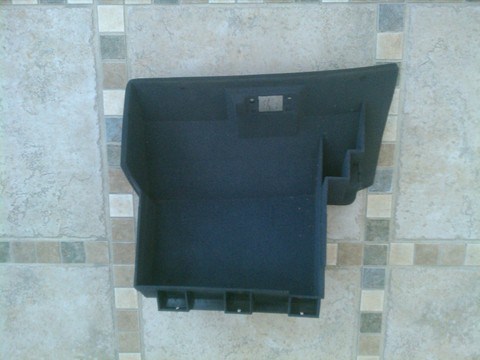
This experience really inspired me to go look in person at what’s actually going on. It reminds me of when I worked at an automobile assembly plant (not for BMWs, sadly). The production control folks had recently managed a change by which cars of a particular model would be fitted with chrome tips on their exhausts. The parts were ordered, brought to the production line, and the assembly instructions were changed to tell workers to put the chrome tips on. But, at the end of it all, my job included being the reality-check person, to go see if in fact all of this planning had actually resulted in chromed-tip exhausts on cars exiting the assembly line. For me, there’s nothing as solid and reassuring as seeing something first-hand.
So, today’s project involved Mass Air Flow Meters on the M30 engine. I own a 1980 BMW 633 CSi, a 1992 BMW 735i, and several models in between, including a 1984 BMW 633 CSi and a 1984 BMW 733i. My tech and I inspected the mass air flow meters on all of these cars, and checked the part numbers. Of course, it’s possible that some of these parts were not originally on the car, but I’ve personally driven each of these cars so I know that the part at least works on that car.
Although the 1992 car has a pretty plastic cover on top of the mass air flow meter, when the cover is removed, the part is the same as on all the other models we analyzed. And so, now we have a good handle on mass air flow meters for the M30 engine.
There are still a million things we DON’T know for certain, but it’s nice to have a fairly good handle on at least this tiny part of the puzzle.
That’s the sort of confidence and certainty that we enjoy.
Headlight Switch
The headlight switch on my 1984 BMW 633 CSi has a round knob, and the light switch on my 1986 BMW 528e doesn’t. The latter car has a bar that slides up and down. So, this is one aspect where the 5-series and 6-series cars don’t use the same part.
I asked my tech to replace the failing light switch on my 6-series car with a part from a 6-series donor car. When the work was complete, everything worked fine. But, when I saw the donor car, it still had its light switch. Puzzled, I asked my tech where he’d gotten the light switch from, and he pointed to a 1987 BMW 325.
After inspecting the one that he removed from my 6-series car to yet another one that he’d removed from a 3-series car, my conclusion is that these headlight switches are similar or identical.
Removing the Catalytic Converter Section
The front of the catalytic converter section is shaped like a “Y” with each of the two legs attaching to an exhaust manifold, enabling three cylinders each. The front and rear exhaust manifold attachment points both use three studs and 15mm nuts each. To get them off is hard. One way that works is a wobbly extension and a long extension. I put the 15 mm socket on the fastener, with the long extension hanging down, threaded through the maze of bars underneath the car. Then, I attached a ratchet and used that to loosen the nut.
The back of the catalytic converter section attaches to the rear muffler section with two flanges, each of which uses a similar three-bolt pattern as at the exhaust manifold.
Even with the front and back fasteners removed, I found it impossible to remove the catalytic converter section unless I jacked the car high up in the air and also remove the front anti-sway bar. Even then, it took a lot of juggling and maneuvering.
Removing the Front Anti-Sway Bar
The front anti-sway bar is attached towards the center with a 13mm nut-and-bolt combination that will tend to spin freely as a pair unless you prevent that with a 13mm wrench at each end.
The front anti-sway bar is attached towards the outside with a 17mm nut-and-bolt combination that will also tend to spin freely as a pair unless you prevent that with a 17mm wrench at each end. This is more tricky. For the outbound wrench position you might well need to shove the rubber cover out of the way so that you can get the 17mm wrench into position.
There are two places at each end where you can remove the 17mm attachment, either towards the top or towards the bottom.
In-Tank Fuel Pump
I grew up with carburetted BMWs in hot South Africa. The cars would get so hot that the fuel in the lines would turn into vapor, which a fuel pump can’t pump. It only handles liquid. The car then stalls and won’t start until it’s cooled down. This situation is called “vapor lock.” It could be resolved faster by laying cold, wet towels around the fuel lines near the carburetors, but it wasn’t a great situation.
A few years ago, I bought a BMW 735i in the San Diego area, and while driving it up the long incline on the freeway out of San Bernardino towards Las Vegas, the car got vapor lock and stalled. As if that wasn’t bad enough, a few months later I bought a 733i in the same general area, drove it on the same road and experienced the same thing in the same place.
The fuel-injected BMWs of the mid-1980s (and presumably also before and after) are fitted with an auxiliary fuel pump inside the tank, whose task is to keep the lines pressurized regardless of what the main fuel pump is doing. This prevents vapor lock.
If the main fuel pump fails, the auxiliary fuel pump cannot generate enough pressure to keep the engine going. Its only value is in preventing vapor lock.
If the auxiliary fuel pump fails, the fuel can still flow through the pump, so it’s not as if failure of the auxiliary fuel pump makes the main fuel pump fail. But, indeed, the cars are then vulnerable to vapor lock.
To get to the auxiliary fuel pump (a.k.a. in-tank fuel pump) on my 1984 BMW 633 CSi I removed the carpet, and then on the passenger side I found a black round plate attached to the trunk floor with three Philips screws that I removed.
I could not remove the auxiliary fuel pump setup without first removing the in-tank fuel level sensor, which required me to remove four 8mm nuts, each of which has a little washer. With the nuts removed, I could slide the sensor up and out, after I removed its electrical connector.
Then, I removed the six 8mm bolts that held the auxiliary fuel pump attached to the tank, and after I removed its electrical connector and its two fuel lines, I could twist it through some weird angles and pull it out of the tank.
The unit has a large, screened horizontal fuel pickup that’s shaped almost like a foot. It’s attached to a down-pipe that’s sort of like a leg. The pump unit and the various lines & hoses are shaped in the way you’d expect this sort of thing to look like, in order to work.
Finding good used units are likely to be a difficult task. So far, every 6-series and 7-series unit I’ve tested has been bad.
E24 Hood Struts
I was working on my 1984 BMW 633 CSi when I knocked loose a prop and the hood fell on my head. Sadly, this isn’t the first time this has happened. I used a long roll of strong cardboard to prop the hood up, and before that I used a piece of wood. It’s not very elegant.
Today, I finally got sick of it. I found a good used pair of hood struts. How do I know they’re good? Together, they hold up a hood in cold weather (close to freezing). In warmer weather they’ll do better yet.
The struts detach using clips that you can slip free of their respective studs. You can do this using your fingernails, if you don’t care how they look afterwards. Better yet, use a flat-tip screwdriver.
I tend to lose about one out of every four clips I remove, and I destroy maybe one out of every three clips I remove. I hope for your sake you’re smarter than I am.
With the clips off, the hood struts are easy to remove and re-install. It’s good to remember that the thick part goes at the bottom.
It’s trivially easy to slip the clips back on.
No surprise, I offer good used hood struts. The dealer price for these clips surprised me. As I recall they were $6 each so if you don’t wanna pay that much, keep me in mind. I charge $1 each.
E24 Inline, Main Fuel Pump Bench-Testing
I am very wary of fuel-related fire dangers, so I prefer to work with Diesel when I test fuel pumps. The Diesel has no materially adverse effect and it’s safe.
I test inline fuel pumps by sticking a hose on each end, and then sticking each hose into a can that’s part-way full of Diesel fuel. Then, I hot-wire the pump terminals using a stand-alone workbench 12V battery that has some alligator clips (and an inline fuse) as part of the wiring.
If all goes well, the pump makes a noise like an electrical motor is running (mostly because it is) and it sucks fuel from one can and pumps it into the other can. I use two cans in case I mix something up by mistakes, so I don’t ever run the fuel pump without fuel in it, since that’s a way to overheat and kill the pump.
E24 Inline, Main Fuel Pump
The main fuel pump of my 1984 E24 recently self-destructed so I learned a bit about these parts.
Basically, they’re very generic. The same part is used on many other contemporary BMW models, and some parts houses even offer the same part for the early E30 as for the E24.
Basically, the pump is shaped like a metal tube, and the “in-flow” side is the one with the thicker hose, on the side away from the electrical terminals.
The terminals are marked “+” and “-” respectively though the markings can be hard to discern especially if the outside of the pump is dirty. Another way I identify the positive side is that it’s the one with the slightly thicker post, the one that takes the 8mm nut. The slightly narrower one is the negative side, and it takes a 7mm nut.
On my E24, the pump was mounted in a removable cradle that it shared with the inline main fuel filter.
Three 10mm nuts affixed the cradle to the body thanks to some studs protruding downwards.
M30 Crank, No-Start Fix: Fuel Supply … Wiring to the In-Line, Main Fuel Pump
When I hot-wire the connection to the in-line, main fuel pump, the pump runs. Otherwise, it doesn’t. This tells me that the car’s wiring is not bringing “negative” to the pump via the black wire, or it is not bringing “positive” to the pump via the green wire, or both.
So, the next step is for me to go check that. The methodical way would be to suspect that the negative connection is good, which I could do my running a loooong wire from the positive terminal of the car’s main battery to the green wire on the fuel pump. If it runs, that tells me the negative (black) cable is doing its job, and the positive one isn’t.
I’m inclined to skip this step and see if I can find an easy fix first.
I read up on the fuses, and fuse number 11 is a light blue, 15A fuse that protects the fuel supply. Fuse number 1 is nearest to the rear of the engine. So, I pull fuse number 11 … and drop it in the innards of the car’s engine compartment. Dangit.
I stick a test light in the fuse hole, upright, and I crank the engine. Aha! The light energizes. Next, I replace the fuse, and crank the car. Vroom. 🙂 It starts, it runs. Problem solved. Yay!
I’m guessing that the fuel pump self-destructed, and that drew a lot of current, and in turn that blew the fuel pump fuse. So, it was the classic problem of two separate things being wrong and fixing any one of them wouldn’t solve the problem.
 6 Series Parts
You must be logged in to post a comment.